
MS-polymer sealant is a flexible sealant or adhesive made with a silane-modified polymer. The family name does not specify one universal chemistry or guarantee a particular performance—selection depends on the exact grade and joint.
What is MS-polymer sealant?
MS-polymer sealant is a common name for elastic sealants and adhesives made with a silane-modified polymer. The abbreviation is used inconsistently across the market: “modified silane,” “silane-terminated polymer” and “hybrid polymer” may appear in product descriptions, but they do not identify one universal formula.
Silane-modified polymers are a family of base materials used in formulated sealants and adhesives. The family name alone does not confirm a finished product’s exact chemistry, intended use, or performance.
How does it cure?
Many one-component sealants in this family cure when atmospheric moisture reacts with reactive silane groups in the polymer. The reaction forms an elastic network, but the cure profile depends on formulation and application conditions.
In a moisture-cure formulation, atmospheric moisture participates in reactions at the polymer’s reactive silane groups, forming a crosslinked elastic material. The surface typically cures before material deeper in a bead; the actual skin and through-cure behavior depends on the grade and the conditions. Temperature, humidity, bead geometry and ventilation can all matter. Use the product TDS for cure information—there is no single cure time for “MS polymer.”
What the polymer family can tell you
- It points to a silane-modified polymer chemistry, not a specific performance class.
- The cured material is intended to remain elastic in products designed for joint sealing.
- Adhesion, movement capability, primer need, paintability, weathering and cure rate are grade-specific.
MS polymer vs silicone vs polyurethane
All three families include elastic sealants, but the polymer chemistry and product formulations differ. Selection should start with the joint and service conditions, then move to a grade whose data sheet supports them—not with a claim that one family is always “better.”
| Family | What distinguishes it | Questions to check |
|---|---|---|
| MS polymer / SMP | Silane-modified polymer formulations; “MS” and “hybrid” naming varies by manufacturer. | Does the exact TDS confirm the chemistry, substrate pair, movement duty and required finish? |
| Silicone | Silicone-polymer sealants are offered in different cure chemistries and purpose-made grades. | Is it acetoxy or neutral cure? Is the selected grade intended for glazing, sanitary use or the stated exposure? |
| Polyurethane (PU) | Polyurethane sealants are formulated for particular construction, movement, metal-sealing and other duties. | What do the grade’s data sheet and joint-design instructions state about movement, primer and exposure? |
Where is MS-polymer sealant used?
Depending on its formulation, an elastic silane-modified sealant may be designed for selected construction joints or compatible elastic bonding tasks. Substrate compatibility, movement duty, and exposure must be confirmed for the exact grade.
Confirm the actual joint function before choosing: a movement joint, a static connection, an air seal and a bonded assembly can place different demands on a material. Also confirm whether the joint faces are compatible and adequately prepared, and whether the required movement, exposure and appearance are addressed by the grade.
Describe the job before comparing products
- What are the two adjoining materials, and what coatings or finishes are present?
- Is the joint expected to move, and are its dimensions known?
- Will it face rain, UV, standing water, cleaning chemicals, traffic or temperature changes?
- Does the finished joint need to be painted, hidden, exposed or regularly cleaned?
Joint design: why the bead shape matters
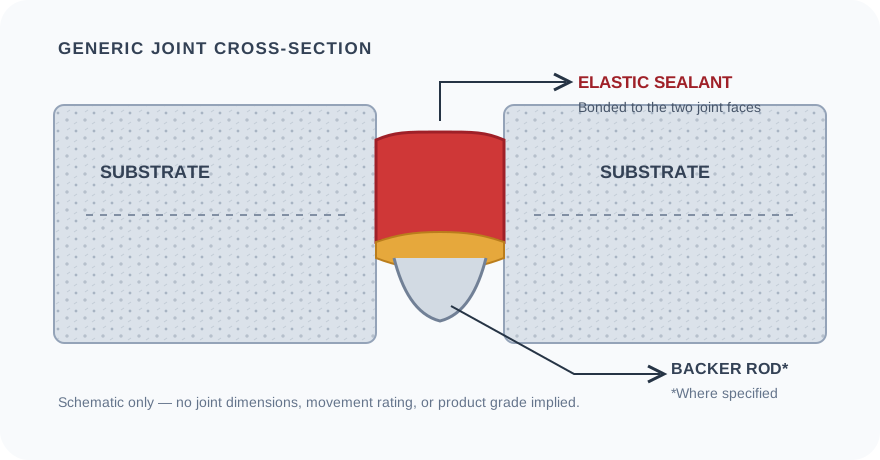
A sealant bead works by adhering to the designed joint faces while deforming with the joint. Joint width, depth, expected movement, backing material, and adhesion to the sides all influence performance. Unintended three-sided adhesion can restrict movement, so joint geometry must be considered during design.
A backer rod or bond-breaker may be part of the joint design, but it is not a universal instruction. Use only the backing type, dimensions, primer and geometry required by the exact sealant documentation and project specification.
How to select and apply a grade
- 1
Define the duty
State whether the requirement is a moving joint, static joint, perimeter seal or bonded assembly. Record the joint dimensions and expected movement where applicable.
- 2
Identify every joint face
List the substrates, existing coatings and surface condition. Check the TDS for compatibility, surface preparation and any required primer; do not assume one product adheres to every material.
- 3
Match the exposure
Describe indoor or outdoor location, moisture, UV, temperature, cleaning, chemicals, traffic and any other project demand. Ask for evidence that the selected grade is intended for those conditions.
- 4
Follow the product instructions
Use the specified backing, tooling, application and cure conditions. Do not invent bead dimensions or timing, and allow the material to cure and remain protected as the product documentation requires.
- 5
Verify the finished assembly
Where compatibility or appearance is uncertain, request a trial or adhesion check approved by the project team and follow the manufacturer’s test procedure.
What a family label cannot promise
“MS polymer” does not, by itself, specify movement class, tensile strength, primerless adhesion, paint compatibility, UV life, fire performance, chemical resistance or suitability for permanent immersion. Those are product- and test-specific claims. A joint sealant is also not automatically a substitute for a continuous waterproofing membrane or a structural connection.
Before a product is specified or quoted, ask for its current TDS and SDS, exact product name, relevant application details and confirmation of current availability. If a grade is described only as hybrid or AST polymer, request documentation that explicitly identifies the chemistry rather than treating the names as interchangeable.
Useful information to include in an enquiry
- The joint detail or a clear sketch, including width and depth if known.
- Substrate names, coatings, location and expected movement.
- Exposure conditions and any finish or paint requirements.
- The exact performance requirement and any candidate product TDS or project specification.
Frequently asked questions
Is MS polymer the same as silicone?
No. They are different polymer families, even though product names may use “modified silicone” or “hybrid” inconsistently. Confirm the exact chemistry in the product documentation.
Can MS-polymer sealant be painted?
Some specific products permit painting, often with compatibility conditions or a test recommendation. Check the exact TDS; paintability is not guaranteed by the family name.
Is MS-polymer sealant waterproof?
A selected grade may be designed to seal a defined joint against water under stated conditions. The name alone does not establish immersion or water-pressure suitability, and joint sealant is not automatically a full waterproofing system.
Will MS-polymer sealant stick to every surface?
No. Adhesion depends on the grade, substrate, coating, preparation and sometimes primer. Check the manufacturer’s compatibility guidance and test where required.
Is every hybrid or AST-polymer sealant an MS polymer?
No. Market terminology is not a reliable substitute for a chemistry statement. Confirm the product’s exact chemistry and current TDS or SDS.